
Health and Wellbeing
Health and wellbeing in Milton Keynes is at a turning point. Those working within the NHS are anticipating the impact of proposed structural changes, while those supporting and advocating for the community want to ensure these changes do not widen healthcare inequalities.

A particular pressure point is access to GP services. In 2023/24, the Bedfordshire, Luton and Milton Keynes Integrated Care Board (BLMK ICB) area had among the highest number of patients per fully qualified GP (FQGP) in the country [1], meaning that GPs and other practice staff in Milton Keynes and neighbouring areas are managing many more patients than average.
Access issues are echoed in the Great Big MK GP Survey from Healthwatch, which found that difficulties with GP access were the number-one reason people sought help in 2024/25. [2]
- 71% of people trying to access care saw a non-GP
professional - Only 25% of people with additional accessibility needs
felt their needs were met
These pressures are also felt in mental health provision. Healthwatch MK reports that long waits are leaving people distressed and without support. Healthwatch is also concerned about the recent closure of the Recovery College in Milton Keynes: a training and resource centre with educational tools for self-management of mental health difficulties. Those needing this service will now have to travel to Bedfordshire or London, or rely on digital resources that may not be suitable for everyone. [3]
Mental health provision is also very important for supporting young people in the city, as admissions data from MK Hospital Charity shows:
- There has been a 20% increase in young people
presenting with mental health issues [4]
The rollout of Mental Health Support Teams (MHSTs) in schools is a welcome initiative, with parents able to access online introductory sessions, but demand already outstrips supply. [5]
Work is also needed to consider the healthcare needs of Milton Keynes’ ageing population, as it continues to grow.
Stat: The 70 and over population in Milton Keynes is forecast to grow by 82% from 2023 to 2043 [6]
Di Cook, Project Director for Adult Learning at MK College, explains that some barriers to GP access for older people actually comes from digital exclusion:
“We’ve had people [at MK College’s Digital Skills workshops, Tea and Tech] who haven’t been to the doctor when they’ve needed to because they didn’t understand how to book an online appointment.”
Recent projects have focused specifically on the impact of dementia in Milton Keynes. It is estimated that 982,000 people have dementia in the UK, which is projected to rise to 1.4 million by 2040.
In the NHS Bedfordshire, Luton and Milton Keynes Integrated Care system, nearly 11,000 people have dementia. [7] The OU’s new Age-Friendly Cities and Communities project—winner of the OU CHALLENGE US! Business Award 2024—is currently gathering data to inform how Milton Keynes can become a more dementia-friendly city through strategic planning and infrastructure improvements.
However, considering the role of infrastructure and healthcare systems will be crucial to solving these problems, with new changes in the works. In April 2026, the BLMK (Bedford, Luton and Milton Keynes) Integrated Care Board (ICB) will merge with two other ICBs to form the Central East ICB.
Healthcare workers and advocates in the city are concerned that this will turn MK into a ‘little player in a very big pond’, especially in a context where Healthwatch organisations are being closed. This could create a gap in patient voice advocacy and healthcare system
accountability.
The groups that could be particularly at risk of losing their voices when it comes to advocating for their health needs are:
- LGBTQ+ residents, particularly those not engaged in LGBTQ+ services such as Q:alliance
- Sensory-impaired people (e.g. Deaf people, BSL users,
and the hard of hearing), who are often grouped
together despite differing needs - African communities facing health inequalities
- Low-income, elderly and homeless residents, and those
with mental health needs affected by digital exclusion
High blood pressure (also known as hypertension) offers one example of health inequality. If untreated, it can lead to heart attacks, strokes, kidney disease and vascular dementia. Treatment involves managing blood pressure to safe levels, known as ‘treatment to target’.
People in Black African communities are more likely to be diagnosed with high blood pressure but less likely to get the support they need, and this is a clear issue in Milton Keynes:
Only 48% of Black African groups with high blood pressure are treated to target compared to an average of 62% across MK [8]
These rates mean Black African people in Milton Keynes are more at risk of the serious complications of high blood pressure.
In light of the upcoming changes to the ICB areas, there’s been a move towards community-based health initiatives, with the hope that prioritising preventive care could reduce pressure on the NHS.
For example, Bletchley Pathfinder is an initiative that focuses on supporting a community to understand their health needs, and events continue in 2025. There is, however, concern that funding for similar projects in other neighbourhoods is dwindling.
Vital Thinking
With the city growing faster than its healthcare system, how can we expand community-based initiatives to care for marginalised people?
Milton Keynes Hospital Charity
The Milton Keynes Hospital Charity supports all wards and departments at the hospital. The core team of two, supported by 200+ volunteers, serves patients from neonatal to end-of-life care.
Its role and focus is to bring comfort, enhance patient experience and enable teams to both go above and beyond the NHS standards, and to innovate in new directions. This has become increasingly important in recent years, where Milton Keynes’ growing population, plus other factors, means Milton Keynes University Hospital has one of the highest waiting lists in the country.
65% of patients in MK are waiting longer than the 18-week target for elective treatment in Jan 2024. Milton Keynes has the highest rate of
waiting times in the country. [1]
“Demand for hospital care in MK is still growing steadily at a time when the financial pressures we face are ever-increasing. As a result, we are being required to do more with less. On the back of tremendous efforts by our team, there are some improvements happening — especially in Urgent and Emergency Care — and for patients waiting the longest. The overall picture, however, remains very challenging.” Vanessa Holmes, MK Hospital Charity
In 2024-25, the focus is on placemaking and treatment innovation. Recent projects include:
- Transforming the cardiology waiting area with skylights, comfortable seating and a nature- inspired mural
- Constructing a co-designed mental health crisis room for young people
- Renovating the neonatal unit’s family room and providing an on-site counsellor for parents
- Delivering a sleep apnoea innovation project that reduced waiting times from 6–9 months to 3 months and increased treatment capacity from 300–400 to nearly 800 people per year


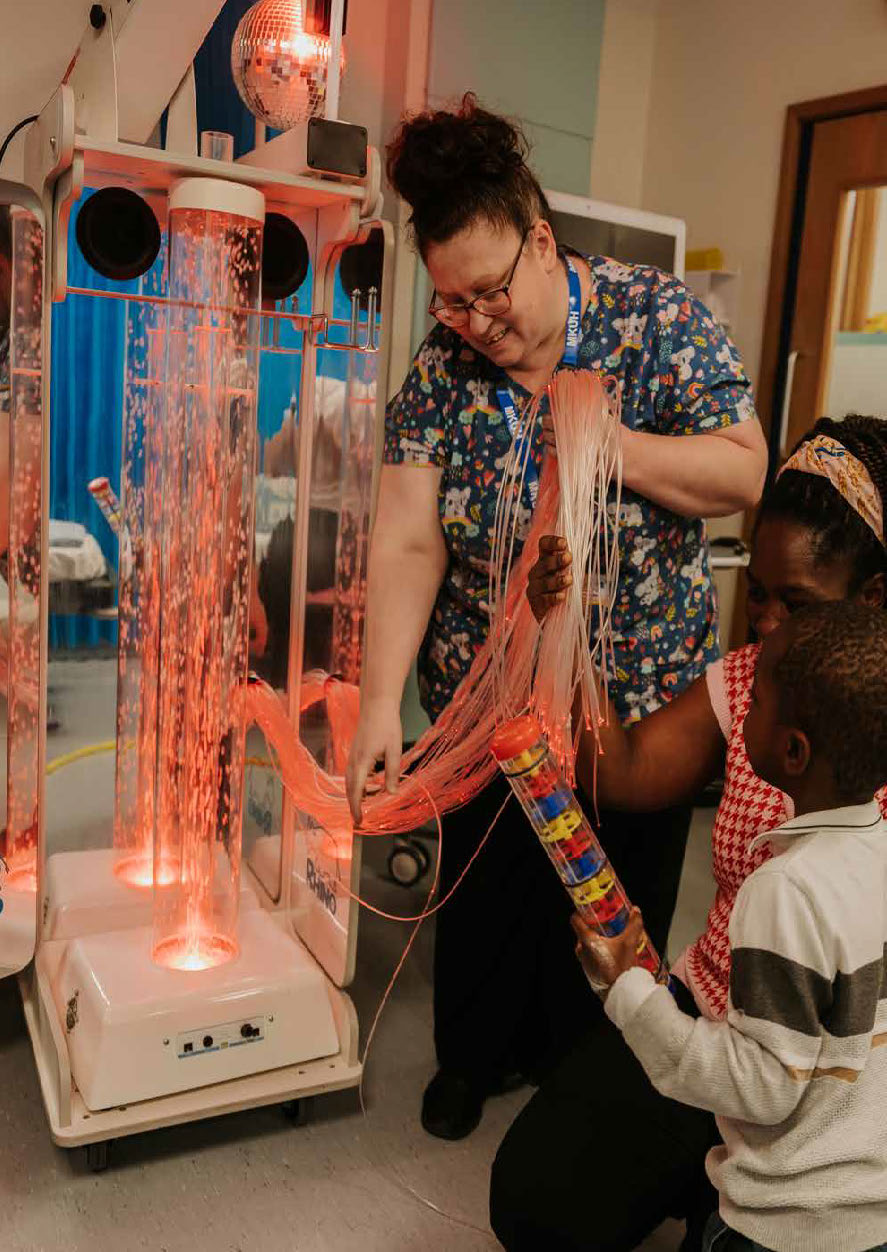
“Demand for hospital care in MK is still growing steadily at a time when the financial pressures we face are ever increasing. As a result, we are being required to do more with less. On the back of tremendous efforts by our team, there are some improvements happening — especially in Urgent and Emergency Care — and for patients waiting the longest. The overall picture, however, remains very challenging.”
Vanessa Holmes, MK Hospital Charity
References:
- “Population, health and healthcare use in Milton Keynes, 2021 to 2043: Director of Public Health Report 2024”, Milton Keynes City Council, 2024; accessed November 2025
- The Great Big MK GP Survey, Healthwatch Milton Keynes, 2024; accessed November 2025
- “Perspectives on mental health services in Milton Keynes”, Healthwatch Milton Keynes, 19 September 2025; accessed November 2025
- Admission information, MK University Hospital 2023-2024, shared by MK Hospital Charity
- “Perspectives on mental health services in Milton Keynes”, Healthwatch Milton Keynes, 19 September 2025; accessed November 2025
- “Population, health and healthcare use in Milton Keynes, 2021 to 2043: Director of Public Health Report 2024”, Milton Keynes City Council, 2024; accessed November 2025
- Projecting Older People Population Information (POPPI), Institute of Public Care, Dec 2023, cited on ‘The Open University: Milton Keynes - An age and dementia friendly city for all’ resource pack
- “Annual Report 2024-2025: Unlocking the power of people-driven care”, Healthwatch Milton Keynes, June 2025; accessed November 2025
Case Study: MK Hospital Charity
- “Need an op? The hospitals with the worst waits revealed”, BBC, 14 March 2024; accessed November 2025
Make an enquiry
Have any questions? Feel free to get in touch with our team.